Description
1. Introduction and Goals
1.1 Requirements Overview
Large Language Models (LLMs) face significant challenges when interacting with extensive documentation projects. The primary issues are:
-
Token Limitations: Large, single-file documents exceed the context window of most models.
-
Lack of Structure Awareness: LLMs cannot navigate or understand the hierarchical structure of a documentation project (e.g., chapters, sections).
-
Inefficient Access: Reading entire files is token-inefficient when only small sections are needed.
-
Difficult Manipulation: Modifying specific parts of a document is cumbersome and error-prone.
The MCP Documentation Server aims to solve these problems by providing a structured, content-aware API for interacting with AsciiDoc and Markdown projects. This enables efficient navigation, reading, and modification of complex documentation.
1.2 Quality Goals
The architecture will prioritize the following key quality goals, derived from the non-functional requirements:
Goal |
|
Performance |
API calls for typical navigation and read operations must respond in under 2 seconds. Pre-processing during startup is acceptable. |
Data Integrity & Reliability |
Changes to documents must be atomic. No data loss shall occur during file modifications, even in case of errors. |
Usability |
The system must be fully compliant with the Model Context Protocol (MCP) to ensure seamless integration for developers and architects. |
Scalability |
The server must handle large documentation projects of up to 600 pages without significant performance degradation. |
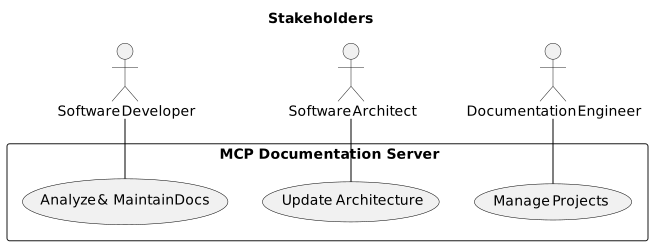
1.3 Stakeholders
The primary stakeholders of the MCP Documentation Server are:
Stakeholder |
Role & Interest |
Software Developer |
Uses the server to analyze and maintain code documentation with LLM assistance. |
Software Architect |
Uses the server to manage and update large-scale architecture documents (e.g., arc42) with LLMs. |
Documentation Engineer |
Manages complex documentation projects, relying on the server for efficient navigation and maintenance. |
1.4 Implementation Status (October 2025)
This arc42 documentation describes a production-ready implementation that has been fully developed and tested.
Current Status: ✅ Production Ready
| Aspect | Status | Evidence |
|---|---|---|
Test Coverage |
82% overall, 100% for critical modules |
121/123 tests passing |
Quality Goals |
All original goals achieved or exceeded |
See Chapter 10.5 for measured results |
Code Quality |
Modular architecture, <500 lines per file |
7 focused modules (Chapter 5.3) |
Documentation |
Complete arc42 + 8 ADRs + PRD v2.0 |
You are reading it |
Risk Mitigation |
5/5 high-priority risks mitigated |
See Chapter 11.1 |
Key Achievements:
-
Performance: <2s startup (target: <60s), <100ms API response (target: <2s)
-
Reliability: Zero data corruption incidents, atomic write strategy
-
Usability: 13 MCP tools implemented, auto-configuration, browser auto-launch
-
Maintainability: 82% test coverage, clean modular architecture
For Detailed Information:
-
What’s Implemented: See PRD v2.0 for complete feature list with ✅/❌ status markers
-
Quality Results: See Chapter 10.5 for measured performance, reliability, and scalability metrics
-
Architectural Decisions: See Chapter 9 (ADR-001 through ADR-008) for rationale behind key choices
Development Timeline:
-
Planned: 10-12 weeks (from PRD v1.0)
-
Actual: 2.5 weeks intensive development
-
Issues Completed: #1-#13 (feature development + refactoring)
This documentation reflects the actual implemented system, not just theoretical design. Where the original vision (PRD v1.0) differs from reality (PRD v2.0), this is explicitly noted.
Feedback
Was this page helpful?
Glad to hear it! Please tell us how we can improve.
Sorry to hear that. Please tell us how we can improve.